The Science Behind the Perfect Projector Screen
There is a familiar sequence of events for many first-time home theater builders. You spend hours researching lumens, contrast ratios, and throw distances. You finally unbox your brand-new hardware, set it up on the coffee table, and eagerly fire it up, pointing the lens squarely at your living room wall.
The image appears, but the excitement fades. The picture feels a bit soft, the colors lack punch, and the dark, moody shadows of your favorite movie look milky and gray.
The immediate reaction is to blame the hardware. But more often than not, the projector is doing its job perfectly. The culprit is the surface you are projecting onto. Treating a painted wall as a substitute for a dedicated viewing surface is the single biggest mistake in home theater design. To truly understand why, we need to look at the physics of light and the science behind the perfect projector screen.
The Hidden Flaws of a Painted Wall
To the naked eye, a freshly painted white wall looks perfectly smooth and neutral. To a beam of projected light, however, it is a chaotic, jagged mountain range.
Standard interior paint is applied with rollers that leave behind a microscopic texture known as “stipple.” When a projector hits this textured surface, the light does not bounce back uniformly to the viewer. Instead, it scatters in hundreds of different directions. This heavy light scattering drastically reduces the sharpness of the image, blurring the crisp edges of 4K pixels and making the entire picture look soft and out of focus.
Furthermore, interior wall paint is rarely color-neutral. Most white paints contain subtle undertones—warm yellows, cool blues, or subtle pinks—to make a room feel cozier or brighter. Your projector is meticulously calibrated to deliver precise color accuracy, but projecting onto a wall essentially applies a permanent, unpredictable color filter over your movie, ruining the creator’s intended color palette.
Controlling the Bounce: Gain and Texture
A purpose-built viewing screen solves the physical limitations of paint through engineered materials. High-quality screens use perfectly tensioned, microscopic optical coatings that completely eliminate texture. This allows the individual pixels to render with razor-sharp clarity, giving you the true ultra-high-definition experience you paid for.
Beyond texture, dedicated screens introduce the concept of “gain.” Gain is a measurement of how much light the screen reflects back at the viewer compared to a standard matte white surface. A screen with a gain of 1.0 reflects light equally in all directions. A screen with a higher gain (e.g., 1.2 or 1.5) focuses the reflected light toward the center viewing area, resulting in a brighter image for those sitting directly in front of it.
By choosing the right gain for your specific room dimensions and seating arrangement, you are actively managing the light to maximize brightness and efficiency, rather than letting it bleed off into the corners of the room.
The Threat of Ambient Light
The most critical challenge in any projection setup is ambient light. If you are watching a movie in a room with white ceilings, light-colored walls, or open windows, the light from the projector bounces off the screen, hits the surrounding room, and bounces right back onto the screen. This washes out the black levels, turning deep shadows into a muddy gray and destroying the image contrast.
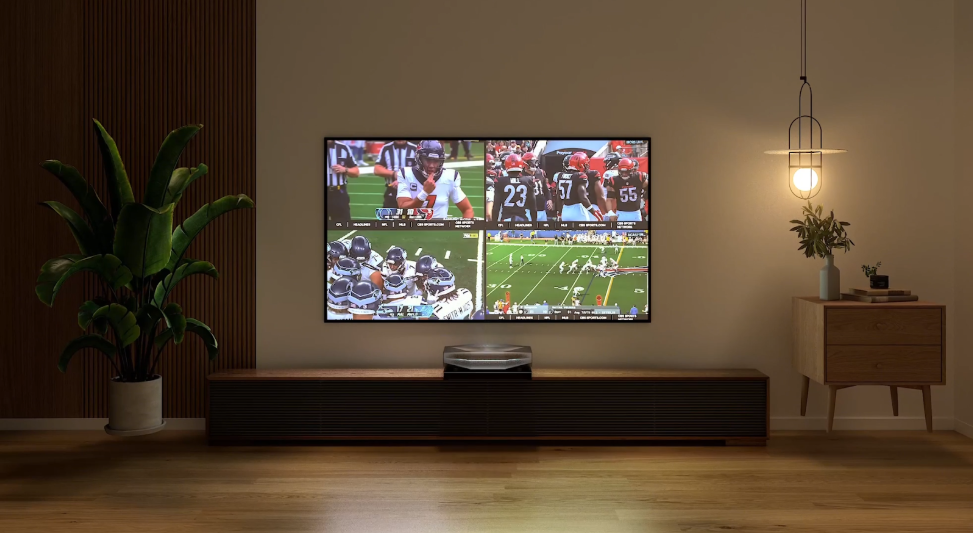
This is where the synergy between your projection engine and your viewing surface becomes critical. If you have invested in a high-end 4k laser projector, you have a device capable of outputting massive brightness and infinite contrast. But if you project that laser beam onto a standard wall or a cheap, non-directional canvas, the room’s ambient light will immediately override the projector’s black levels. The hardware simply cannot overcome a bad surface.
The Engineering Marvel of ALR Technology
To combat the ambient light problem without painting your entire living room matte black, the industry developed Ambient Light Rejecting (ALR) screens. These screens are not just pieces of fabric; they are complex optical lenses.
ALR surfaces are constructed using a microscopic structural pattern—often resembling tiny sawtooth ridges. These ridges are mathematically angled to perform two distinct tasks simultaneously.
First, the angle is positioned to catch the light coming from the projector (whether it is mounted on the ceiling or sitting directly below the screen) and bounce it directly forward into the viewing sweet spot.
Second, the structural ridges are coated with a light-absorbing material on their upper edges. When ambient light from ceiling fixtures or high windows hits the screen, it strikes this absorptive layer rather than the reflective layer. Instead of bouncing back to your eyes and washing out the image, the ambient light is effectively “eaten” by the screen.
Protecting the Investment
Building a home theater is an exercise in synergy. You can buy the most powerful, color-accurate sports car on the market, but if you drive it on bald tires, it will perform terribly. The relationship between your projector and your screen operates on the exact same principle.
A bare wall is a compromise that actively degrades image quality, scatters light, and skews colors. By understanding the optical science behind light reflection and investing in a properly engineered screen, you ensure that every lumen, every pixel, and every color generated by your projector reaches your eyes exactly as the director intended.