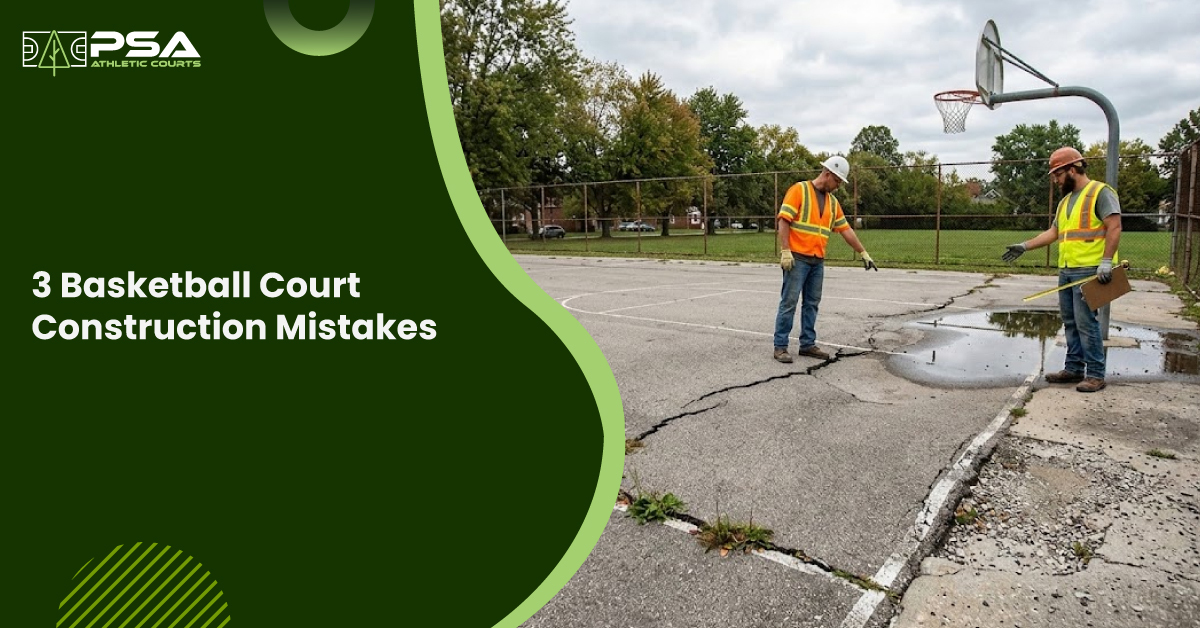
3 Common Errors in Basketball Court Construction Related
Designing a basketball court may appear straightforward, but mistakes in measurement and layout can compromise performance, safety, and long-term durability. One of the most common sources of costly rework in basketball court construction is incorrect dimension planning.
Whether the court is residential, school-based, or commercial, getting the dimensions right is essential. Below are three common errors related to basketball court dimensions and how to avoid them.
Error 1: Miscalculating Regulation Basketball Court Dimensions
Many projects fail because builders rely on rough estimates rather than official specifications.
Standard basketball court dimensions vary depending on use:
- NBA: 94 ft × 50 ft
- High school: 84 ft × 50 ft
- Youth or recreational: Adjustable but proportion-based
Incorrect scaling affects:
- Shooting angles
- Spacing between key areas
- Player safety
Understanding official guidelines through a comprehensive basketball court dimensions guide ensures courts are proportionally accurate.
Error 2: Ignoring Safety Run-Off Space
The playable area is not the only dimension that matters.
Every basketball court requires buffer zones around the perimeter. Insufficient run-off space increases collision risk and reduces usability for competitive play.
Professional design teams consider:
- 3–10 feet of clearance on all sides
- Spectator spacing
- Fencing placement
- Wall proximity (for indoor courts)
According to experienced outdoor court specialists such as Pine State Courts, inadequate safety spacing is one of the most expensive dimension errors to correct after construction.Below are three common errors related to basketball court dimensions and how to avoid them.
Error 3: Poor Alignment Between Surface and Layout
Even when measurements are correct on paper, layout mistakes during surfacing can create misaligned markings.
Common alignment issues include:
- Off-center hoops
- Crooked three-point arcs
- Uneven free-throw lanes
Surface choice also impacts dimension precision. Comparing materials like asphalt and acrylic helps determine which systems allow cleaner line applications and long-term dimensional stability.
Improper layout often results from working with inexperienced contractors rather than specialized basketball court designers.Accurate planning at the beginning protects both the court and the investment behind it.
Why Dimension Accuracy Matters in Basketball Court Construction
Dimension errors affect more than aesthetics. They influence:
- Game performance
- Training quality
- Safety compliance
- Long-term resurfacing costs
A well-designed basketball court maintains correct proportions while integrating surface durability and drainage planning.
Working with qualified basketball court construction professionals ensures dimensional integrity from site preparation to final striping.Accurate planning at the beginning protects both the court and the investment behind it.
Choosing the Right Design Partner
Before starting a project, it’s critical to evaluate expertise carefully. Learning how to find the best basketball court designer near you can prevent dimensional mistakes that are expensive to fix.
For property owners planning new installations, professional court design teams like Pine State Courts provide site-specific evaluations that align regulation standards with real-world space constraints.Accurate planning at the beginning protects both the court and the investment behind it.
Final Thoughts
Dimension-related errors are among the most preventable problems in basketball court construction. By understanding regulation sizing, planning for safety clearances, and ensuring precise layout execution, projects can avoid costly corrections and performance limitations.
Accurate planning at the beginning protects both the court and the investment behind it.