The Hydraulic Cylinder Selection Checklist For Heavy Equipment
Key Takeaways
- Calculate the required push and pull force before choosing the bore and rod sizes.
- Match pressure, flow, stroke, overall length, ports, and mounts to the hydraulic circuit.
- Consider side loading, duty cycle, temperature, contamination, and corrosion exposure.
- Use safe stored-energy procedures before inspection, removal, or testing.
Selecting a replacement cylinder involves more than matching an old part by appearance. The right hydraulic cylinders specification accounts for the machine’s load, system pressure, stroke, mounting geometry, operating environment, and service demands.
A cylinder that fits physically but cannot handle the required force, side load, or cycle rate can cause leakage, poor control, damaged linkage, and unexpected downtime. Start with the machine’s actual job, then verify all measurements and operating conditions before ordering.
Why Cylinder Selection Starts With The Machine
Hydraulic cylinders serve very different functions on excavators, loaders, dump bodies, agricultural equipment, presses, and material-handling systems. A lifting cylinder may need controlled holding capacity, while a clamping cylinder may need repeatable force and high cycle life. Price, bore size, and outside dimensions alone do not define whether a cylinder suits the job.
How Hydraulic Cylinders Create Linear Force
For readers reviewing hydraulic cylinder basics, pressurized fluid enters the barrel and moves a piston connected to a rod. The barrel contains pressure, seals prevent fluid loss, guide rings support moving parts, ports direct fluid, and mounts transfer motion to the machine. In a single-rod, double-acting design, the retraction force is lower than the extension force because the rod occupies part of the piston area.
Machines with unusual dimensions, difficult mounting locations, extreme environments, or specialized performance requirements may require custom hydraulic cylinders rather than assuming a standard configuration will work.
Step One: Define The Load And Required Force
Identify the heaviest load the cylinder must move, push, pull, lift, clamp, or hold. Include friction, linkage-created leverage, shifting loads, impact, and expected shock loads. The basic relationship is Force = Pressure × Piston Area. A larger bore produces more force at the same pressure, but it also requires a larger oil volume and may increase installation space.
Questions To Ask
- What is the maximum working load and the worst-case position of the linkage?
- Does the cylinder require push force, pull force, or both?
- What safety margin is appropriate for normal and shock loading?
Step Two: Confirm Pressure And Flow Requirements
Check the machine’s normal operating pressure, relief setting, and likely pressure spikes. The cylinder, hoses, fittings, ports, valves, and seals must all be compatible with the circuit. Higher pressure capacity does not correct an undersized bore or weak rod. Pump flow determines cylinder speed, so confirm that the desired travel time is realistic for the available flow.
Step Three: Measure Stroke And Installation Space
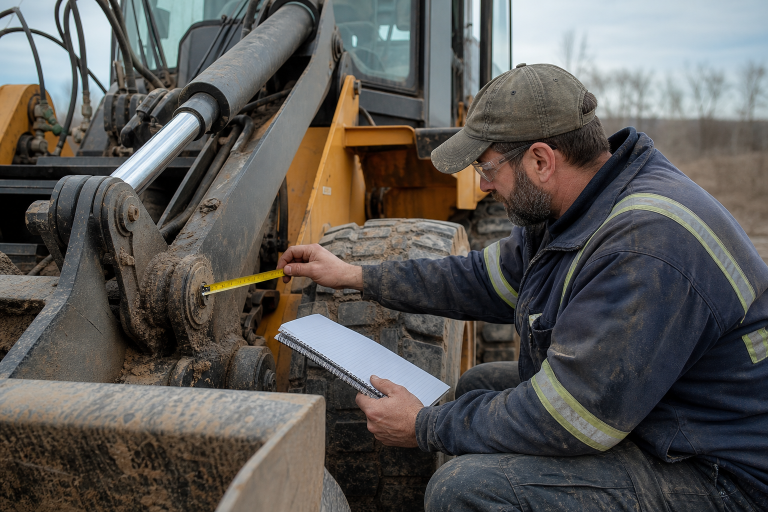
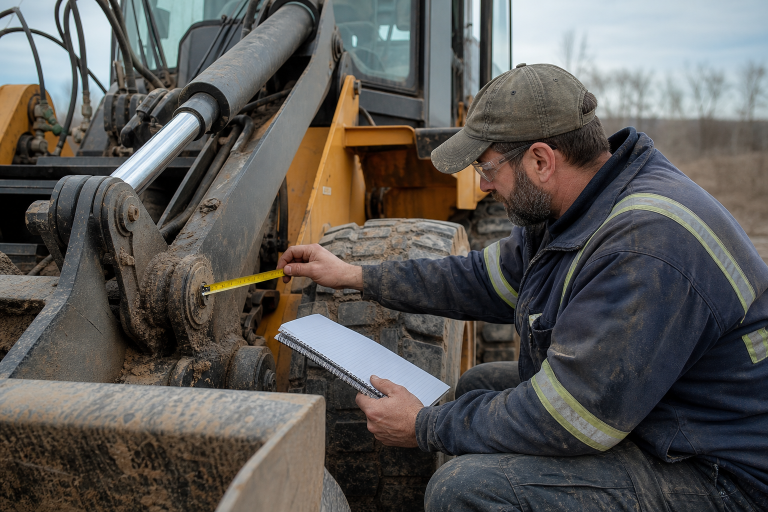
Stroke is the rod travel from fully retracted to fully extended, but it is only one required measurement. Record retracted length, extended length, pin-to-pin dimensions, mounting width, pin diameter, port position, port thread, and clearance around the barrel and rod. A cylinder can have adequate force and still be unsuitable if it interferes with the machine’s movement path.
Step Four: Select The Right Cylinder Design
- Single-acting cylinders use pressure in one direction and rely on gravity, a spring, or an external load for the return stroke.
- Double-acting cylinders provide controlled extension and retraction.
- Telescopic cylinders provide long travel from a compact retracted length.
- Tie-rod cylinders are common in industrial applications where service access is important.
- Welded cylinders often provide compact packaging for mobile equipment.
Step Five: Check Rod Strength And Side Loading
Long strokes, compression loads, and off-center force can bend or buckle a rod. Inspect pins, bushings, brackets, and linkage alignment rather than blaming the cylinder alone. Uneven rod wear, scored chrome, gland leaks, jerky movement, loose pins, and visible deflection are warning signs. Correcting worn mounting components can be as important as replacing the cylinder.
Step Six: Match Materials And Seals To The Environment
Seal material and surface protection should match the hydraulic fluid, temperature range, moisture, abrasive dust, mud, salt, and chemical exposure. A clean indoor press may have very different needs from farm, marine, mining, or construction equipment. Protect exposed rods during storage and transport, since corrosion or impact damage can quickly shorten seal life.
Step Seven: Review Speed, Cushioning, And Cycle Rate
Fast movement is not always safer or more productive. High flow can create abrupt stops, heat, and stress at the end of travel. Estimate cycles per hour and per day, confirm the pump and valve capacity, and consider cushioning where a heavy load must stop smoothly. Excessive throttling may control speed, but it can also generate unwanted heat.
Step Eight: Use A Safe Inspection And Replacement Process
Hydraulic systems may retain dangerous pressure after the pump stops. Follow hydraulic lockout and stored-energy safety practices before disconnecting components. Park on stable ground, lower or mechanically support raised equipment, shut down and lock out the power source, relieve pressure according to the service procedure, and restrain anything that could move. After installation, inspect for leaks and test at low speed with people clear of moving equipment.
Common Selection Mistakes
- Choosing by bore size while ignoring pull force, rod diameter, and mounting geometry.
- Using the wrong stroke, retracted length, ports, or pin dimensions.
- Ignoring pressure spikes, side loading, temperature, and fluid compatibility.
- Replace the cylinder without repairing worn pins, bushings, or brackets.
A Simple Specification Sheet
Before requesting a replacement, gather the machine application, push and pull force, operating pressure, required stroke, retracted and extended lengths, bore and rod sizes, mount style, pin dimensions, port details, travel speed, cycle rate, fluid type, temperature range, and environmental exposure. Note any need for cushioning or position sensing.
Final Checklist Before Ordering
Confirm the exact machine function, calculated force, available pressure and flow, physical dimensions, rod-strength requirements, mounting details, seal compatibility, and safe installation plan of the hydraulic cylinder. Comparing this information with the machine manual helps prevent poor fit, premature wear, leaks, and unsafe operation.