The Hidden Dangers of Skipping Professional Water Damage Restoration
The decision to handle water damage without professional restoration rarely feels like a decision at all. The flooding has been dealt with, the visible water is gone, and calling a restoration company feels like an overreaction when the place looks, for all practical purposes, fine. That reasoning is understandable. It’s also responsible for a category of home damage problems that are significantly more expensive and disruptive to fix than the original water event would have been.
The dangers of skipping professional water damage restoration are real, but they’re not always the ones people expect. The structural and mold risks are widely discussed. What gets less attention is the insurance exposure, the HVAC contamination risk, the distinction between different categories of water damage, and the specific ways that incomplete restoration creates liability for homeowners who think they’ve solved the problem.
Not All Water Damage Is the Same Category
This is the starting point that shapes every other decision about how water damage should be handled, and it’s the one most homeowners skip entirely.
The restoration industry classifies water damage into three categories based on the contamination level of the water source. Category 1 is clean water from a supply line, an ice maker connection, a rainwater intrusion before it contacts contaminated surfaces. Category 2 is grey water, containing some level of contamination, typically from washing machine overflow, dishwasher discharge, or toilet overflow without solid waste. Category 3 is black water, which is sewage, floodwater that has contacted the ground, or any water that has been standing long enough to develop significant microbial contamination.
The category determines what the remediation process needs to achieve, and misidentifying the category is where homeowners doing their own restoration create serious problems. Water that enters a basement during a flood event is almost always Category 3 by the time it’s dealt with, regardless of what it looked like at the source. Ground-contact water carries soil bacteria, potentially chemical contamination, and biological material from whatever the ground outside contains. Treating Category 3 water damage with Category 1 protocols, running a dehumidifier and wiping surfaces, leaves contamination in place that will cause ongoing health and structural problems.
Category 2 water that is not properly remediated within a relatively short window becomes Category 3. The escalation happens through microbial growth in standing water and saturated materials, and it happens faster than most people expect. A washing machine overflow that’s cleaned up the same day is a very different problem from the same overflow discovered two days later.
Professional water damage restoration starts with proper category assessment because the entire subsequent process depends on it.
The Insurance Problem Nobody Tells You About
Skipping professional water damage restoration has insurance implications that extend well beyond the immediate damage event, and understanding them changes the cost calculation considerably.
Most home insurance policies that cover water damage include provisions about mitigation. The policyholder is expected to take reasonable steps to prevent further damage after a covered event. What counts as reasonable mitigation is where things get complicated. A policyholder who documents professional restoration, with the assessment report, the drying logs, the moisture readings before and after, has clear evidence that they met the mitigation obligation. A policyholder who mopped up and ran a fan, and then filed a claim six months later when mold appeared in the walls, is in a much weaker position.
Insurance companies can and do deny or reduce claims on the basis that the damage resulted from inadequate mitigation rather than the original covered event. The mold that appeared in the walls six months after a flooding incident is, from the insurer’s perspective, potentially the result of the homeowner’s failure to restore properly rather than the flooding itself. Proving otherwise without professional documentation is genuinely difficult.
The documentation that professional restoration companies produce, moisture mapping reports, drying logs showing daily progress toward drying targets, photographs at each stage of the process, is specifically useful for insurance purposes. It establishes that professional-grade remediation occurred, what the condition of the property was at each stage, and what materials were affected. This documentation is difficult to produce retroactively and has real value in any subsequent insurance interaction.
For properties where the water damage event itself is insured, the cost of professional restoration is often covered. Calling the insurance company before beginning any work, and before hiring any contractor, is the right sequence. Restoration work that begins before the insurer has been notified can create complications, even if the work itself is appropriate.
What Happens to HVAC Systems After Water Damage
The heating, ventilation, and air conditioning system is the route through which water damage in one area of a property becomes a whole-building problem, and it’s consistently underaddressed in DIY restoration approaches.
When floodwater or significant moisture intrusion affects a property, the HVAC system is exposed to that moisture and whatever it carries. Ductwork in a flooded basement, air handlers in a water-damaged utility room, return air registers near affected areas, all of these become potential vectors for spreading contamination through the rest of the building. Running the HVAC system to help dry out a space after water damage, which seems intuitive, can pull contaminated air from affected areas and distribute it throughout the building.
Mold in an HVAC system is a distinct problem from mold on a wall surface. Wall mold can be physically remediated. HVAC mold is distributed through the system every time the equipment runs, and the exposure it creates affects every room the system serves. Occupants experience respiratory symptoms that seem unrelated to any visible damage, because the source is in the air supply rather than on a visible surface.
Professional water damage restoration includes assessment of whether the HVAC system has been affected and, where it has, either isolation of the system until the affected areas are dried and treated, or cleaning of ductwork and components as part of the restoration scope. Neither of these steps is part of a DIY drying process.
The Contractor Trap
When homeowners do decide to bring in outside help after water damage, a common mistake is hiring a general contractor or handyman rather than a specialist restoration company. The distinction matters more than most people realise.
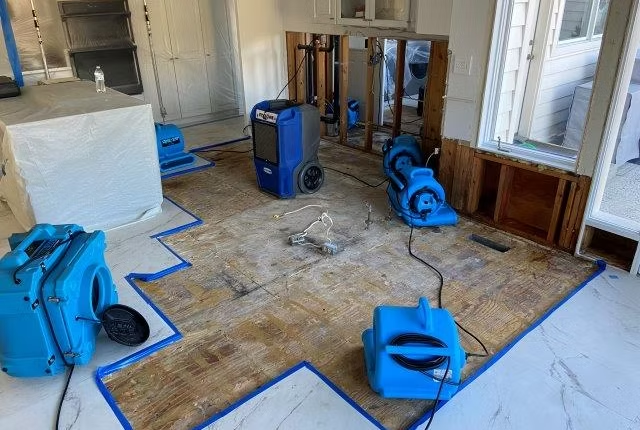
A general contractor’s value is in construction: framing, finishing, installation. Their training and equipment are designed for building, not for drying, decontaminating, and restoring. Most general contractors do not own industrial desiccant dehumidifiers, moisture meters calibrated for structural materials, or thermal imaging equipment. They can replace the drywall that got damaged. They are not equipped to verify that the framing behind it has been dried to safe moisture content before the new drywall goes on.
The failure mode from this combination is predictable. The replacement drywall looks fine. The moisture content in the framing behind it was never verified because nobody had the equipment to measure it. Mold develops in the enclosed wall cavity over the following months, and the renovation work has to be opened up and redone.
Professional water damage restoration companies are specifically equipped and trained for the drying and decontamination phase that needs to happen before any reconstruction begins. The reconstruction itself might still involve a general contractor, but the sequence matters: restore first, rebuild after, not rebuild over unrestored damage.
The Smell That Doesn’t Go Away
Persistent musty odour after water damage is one of the most reliable indicators that the restoration process was incomplete, and it’s a sign that most people wait too long to investigate seriously.
Musty odour comes from microbial activity, predominantly mold and mildew metabolising organic material in a moist environment. It’s not an aesthetic problem that can be addressed with air fresheners or ventilation. It’s a symptom of an active biological process happening somewhere in the building fabric. The smell persisting weeks after the initial water event is not residual odour from the original damage. It’s current odour from ongoing activity.
Odour-chasing in a building with incomplete water damage restoration is a frustrating process because the source is often in an enclosed space: inside a wall cavity, beneath a floor system, behind insulation. It’s not findable by smell alone. Professional restoration companies use moisture meters and thermal imaging to locate elevated moisture behind finished surfaces without opening everything up speculatively. The technology exists specifically to find the problems that aren’t visible, and persistent odour after a water event is one of the clearest indications that those tools are needed.
Trying to resolve persistent post-water-damage odour with surface treatments, ozone generators, or HVAC-mounted air purifiers treats the symptom rather than the cause. Until the source of moisture and microbial activity is identified and addressed, the odour will continue and the underlying damage will progress.
The True Cost Comparison
The argument against professional water damage restoration is almost always a cost argument. Restoration companies are not cheap, and the expense feels disproportionate when the visible damage looks manageable.
The cost comparison changes when the full picture is included. A professional restoration engagement covers drying, decontamination, moisture verification, and documentation. It produces a property that’s been restored to a defined standard, with evidence that the standard was met. The cost is real, and for a significant water event it can be substantial.
The cost of incomplete restoration, realised over time, typically exceeds the restoration cost by a considerable margin. Mold remediation, which involves physical removal of affected materials in addition to treatment, costs significantly more than the drying process that would have prevented it. Structural repair for rot or fastener corrosion that developed from unresolved moisture is a construction project, not a remediation. Rebuilding HVAC ductwork that was contaminated and then cycled through the whole system is expensive, disruptive, and entirely avoidable.
The comparison isn’t between the cost of professional restoration and the cost of doing nothing. It’s between the cost of professional restoration done promptly and the cost of dealing with the consequences of incomplete or absent restoration when they surface, which they reliably do, usually at a time that’s inconvenient and at a scale that’s larger than the original problem.
Professional water damage restoration is not an upsell. It’s the intervention that keeps a water event from becoming a sequence of progressively more expensive problems.