Home Theater Blending Massive Screens with Minimalist Design
For decades, interior designers and homeowners have engaged in a quiet tug-of-war when designing living spaces. On one side is the desire for a pristine, minimalist aesthetic—a room defined by natural light, intentional architecture, carefully chosen textures, and conversational seating arrangements. On the other side is the undeniable appeal of a cinematic, immersive entertainment experience.
Until recently, these two desires were largely incompatible. Upgrading your home entertainment meant sacrificing your interior design to a massive, imposing piece of technology. But thanks to rapid advancements in home theater hardware, the rules of spatial design are changing. We have entered the era of the “invisible” home theater, where you no longer have to choose between a beautifully curated room and a world-class cinematic experience.
The Design Dilemma of the “Black Hole”
To understand the value of an invisible home theater, we first have to look at the problem with traditional television sets. As consumer demand for larger displays has grown, TVs have ballooned in size. While a 100-inch television provides incredible picture quality, it also functions as a massive, glossy black rectangle that dominates the room the moment it is turned off.
Interior designers often refer to this as the “black hole” effect. A giant television absorbs the light in a room, throws off the visual balance of the space, and forces all furniture to point squarely at an empty void. While creative solutions like custom cabinetry or TVs that display digital art offer a partial fix, they are often bulky, expensive to customize at larger sizes, and still dictate the focal point of the entire room.
True minimalist design requires flexibility, breathing room, and intentionality. Having the room permanently anchored by a giant sheet of black glass severely limits those possibilities.
The Paradigm Shift in Projection
Historically, projectors were not a viable alternative for the average living room. Traditional throw projectors required significant distance from the wall, meaning they had to be mounted to the ceiling. This meant dealing with unsightly cables, fan noise above the seating area, and a setup that felt more like a boardroom than a cozy living space.
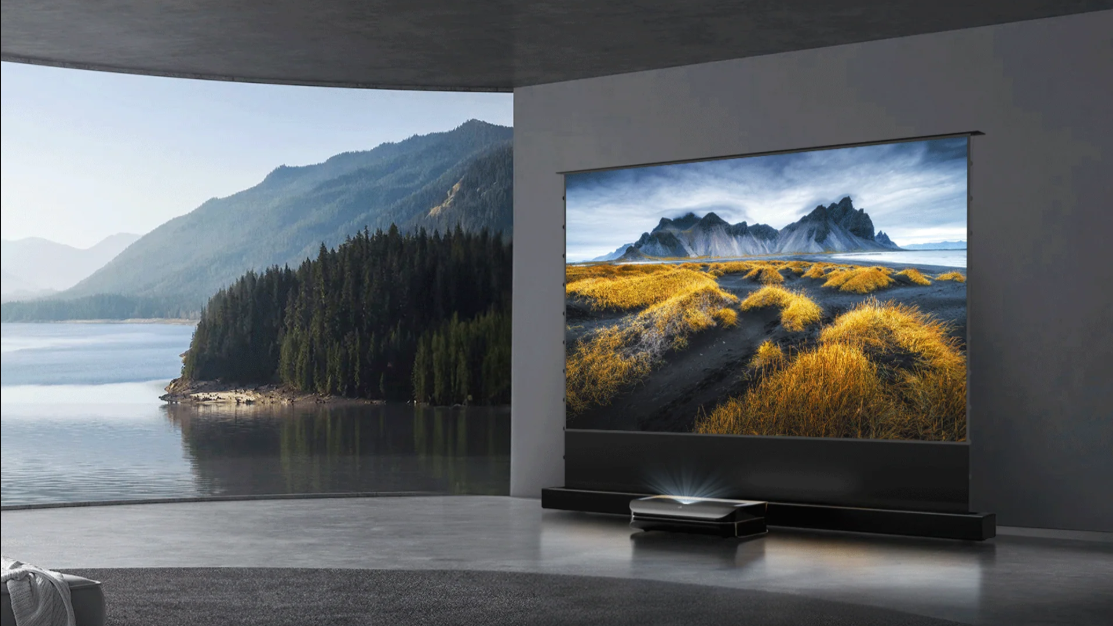
The breakthrough that allows for invisible integration is ultra-short throw (UST) technology. A modern 4k laser projector completely flips the traditional home theater blueprint. Instead of being suspended from the ceiling across the room, these sleek devices sit on a low-profile media console just a few inches away from the wall.
From a design perspective, this is a revelation. The hardware is consolidated into a single, elegant unit that looks more like a high-end soundbar or a piece of modern sculptural tech than a sprawling audiovisual system. Because it sits flush against the wall, it frees up the vertical space in the room, keeping sightlines clean and the ceiling completely untouched.
The Art of the Disappearing Screen
Of course, a projector is only half of the equation; you still need a canvas to display the image. Projecting onto a bare white wall is rarely recommended, as the texture of the drywall will distort the 4K pixels, and standard paint lacks the reflective properties needed for a vibrant picture. However, hanging a permanent 120-inch fixed screen on the wall brings us right back to the original “black hole” problem.
To truly achieve an invisible home theater, the viewing surface must vanish on command. This aesthetic magic is accomplished by pairing your projector with a motorized projector screen.
Modern motorized screens can be seamlessly integrated into the architecture or furniture of the room. A floor-rising screen can be hidden entirely within a custom-built credenza or media cabinet. When the room is being used for hosting or reading, the cabinet looks like a standard piece of minimalist furniture. But with the press of a button, a tensioned, perfectly flat cinematic canvas rises from the woodwork. Alternatively, drop-down screens can be recessed into the ceiling, remaining completely flush and out of sight until movie night begins.
Mastering the Light
The final hurdle in bringing a massive screen into a minimalist, design-forward living room is ambient light. Minimalist architecture often features large, unadorned windows and open floor plans. In the past, watching a projection in a room with natural light resulted in a washed-out, unwatchable image.
This issue has been solved by combining the incredibly high brightness of modern laser light sources with Ambient Light Rejecting (ALR) technology embedded in the screen. ALR screens feature microscopic structures engineered to accept light bouncing up from the projector below, while simultaneously absorbing and deflecting light coming from windows or overhead fixtures.
This allows the invisible home theater to function brilliantly even in the middle of the afternoon. You no longer need heavy, dark blackout curtains or a dedicated, windowless basement to enjoy a vibrant picture.
The Best of Both Worlds
The invisible home theater represents the ultimate convergence of interior design and cutting-edge technology. By utilizing ultra-short throw lasers and disappearing motorized screens, homeowners can finally reclaim their living spaces.
You can design your living room around the fireplace, the architecture, or the view out the window, rather than designing it around a television. When it’s time to entertain, the room transforms instantly, offering a cinematic scale that no traditional TV can match. It is the perfect balance of form and function, allowing you to hide the tech, but keep the magic.