How to Choose the Right Metal for Your Project in Utah
Key Takeaways
- Start with what the finished part must do, not simply which metal looks familiar.
- Shape, wall thickness, and span all influence how a part handles weight and movement.
- Carbon steel, stainless steel, and aluminum each solve different project problems.
- Utah projects exposed to snow, moisture, road deicers, or irrigation need a corrosion plan.
- A complete cut list helps reduce waste, rework, and last-minute ordering problems.
- Safety-critical work should be reviewed by a qualified engineer or building professional.
From Salt Lake City shop builds to rural gate repairs and mountain-property upgrades, choosing the right metal means matching the material to Utah’s working conditions. Local builders, homeowners, and fabricators can compare sizes, shapes, and finishes through an industrial metal supply Utah inventory before committing to a design.
The best choice is rarely the least expensive piece on the rack. A metal project must account for its load, weather exposure, fabrication method, finished appearance, and the practical realities of obtaining the required material when needed.
Table of Contents
- Why Metal Selection Matters
- Start With the Job
- Compare Common Metals
- Choose the Right Shape
- Consider Strength and Load
- Account for Weather and Corrosion
- Plan for Cutting and Joining
- Check Size and Availability
- Avoid Common Mistakes
- Use a Simple Selection Checklist
Why Metal Selection Matters
Material selection affects safety, installation time, maintenance, visual quality, and the long-term cost of a project. Two pieces that appear similar can respond very differently to bending, impact, welding heat, or prolonged moisture. In architectural and construction work, durability, appearance, and long-term performance are often considered together, not as separate decisions.
For Utah projects, the environment can vary sharply. A dry indoor shelf bracket has little in common with a driveway gate that sees snow, runoff, and winter deicers. Selecting the wrong material can lead to rust, excessive deflection, unnecessary weight, or a difficult fabrication process.
Start With the Job
Define the job before comparing price tags. Ask what the finished piece must support, protect, connect, or contain. Consider whether it will carry a steady load, experience repeated movement, or receive occasional impacts. Also decide whether it will live indoors, outdoors, underground, near water, or in a location where it must look finished and clean.
Fabrication matters just as much. Determine whether the metal will be welded, bolted, bent, drilled, painted, galvanized, or powder-coated. A material that works well on paper may be impractical if the available tools, fasteners, or welding process are not suited to it.
Compare Common Metals
Carbon Steel
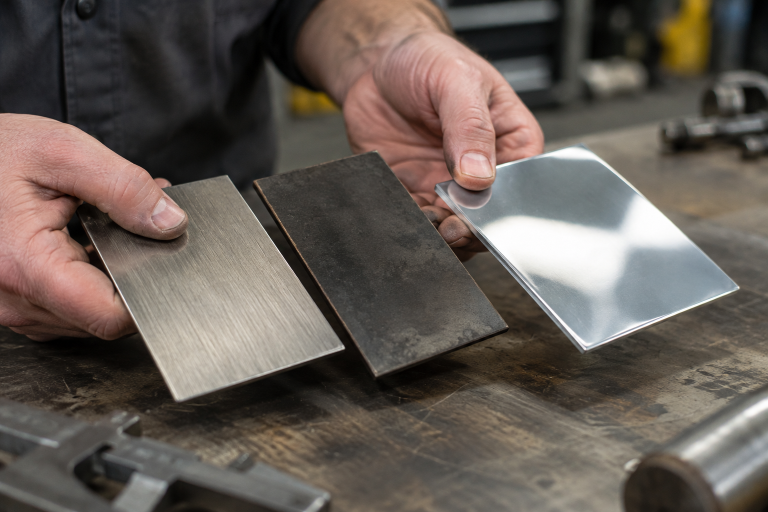
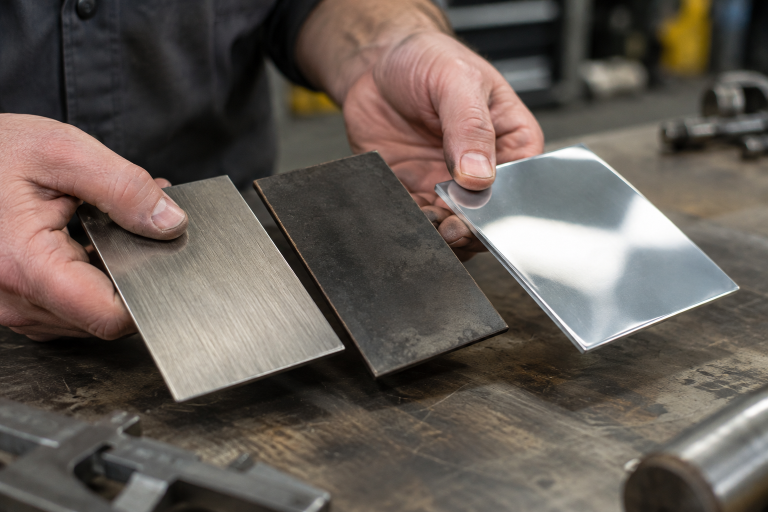
Carbon steel is a practical choice for frames, brackets, supports, repair plates, tables, and many shop projects. It is widely used, available in many shapes, and generally straightforward to cut, drill, and weld. Its main limitation is corrosion. Bare steel can rust when moisture reaches its surface, so outdoor work typically requires paint, primer, galvanizing, powder coating, or another protective system.
Stainless Steel
Stainless steel is often selected for railings, food-related spaces, washdown areas, outdoor fixtures, and decorative components because it resists corrosion better than ordinary carbon steel. It usually costs more, and cutting, finishing, and welding may require different tools or procedures. It is corrosion-resistant, not maintenance-free, especially where contaminants, scratches, or trapped moisture are present.
Aluminum
Aluminum is valued for low weight and useful corrosion resistance. It can be a strong option for signs, enclosures, vehicle-related parts, panels, and portable assemblies. Because aluminum is less stiff than steel for a similarly sized piece, a design may need a different profile or thicker section. Welding aluminum also requires suitable equipment and technique.
Choose the Right Shape
Profile often matters as much as metal type. Many common structural shapes are designed to place material where it can resist loads efficiently. Use the following quick comparison when planning a project:
- Square or rectangular tubing: Good for frames, gates, tables, guards, and equipment supports. Hollow sections can provide useful stiffness without the weight of solid stock.
- Pipe: Useful for rails, posts, bollards, and round assemblies. Confirm whether the project requires pipe dimensions or structural tubing dimensions.
- Angle: Helpful for braces, shelf supports, corners, and reinforcement where two faces are needed.
- Channel: Often used for rails, tracks, frames, and secondary structural members.
- Flat bar and plate: Practical for brackets, tabs, mounting surfaces, gussets, covers, and repair work.
- Round bar: Suitable for pins, shafts, handles, axles, and machined parts.
- Expanded metal or bar grate: Useful where drainage, traction, airflow, or visibility matters.
Consider Strength and Load
Weight, strength, stiffness, and impact resistance are related but different. Strength concerns whether a material can withstand stress without failing. Stiffness concerns how much it bends under load. A long span with limited support can deflect even when the metal does not break, which is why shape, thickness, and support spacing all matter.
Do not select material based on appearance or price alone. A solid bar can suit pins and wear points, while tubing may be better for a large frame that needs stiffness while remaining manageable in weight. Stairs, platforms, guardrails, structural repairs, and vehicle components may require code compliance or professional calculations.
Account for Weather and Corrosion
Dry interior spaces allow more flexibility, but outdoor Utah projects should be planned for rain, snow, condensation, sunlight, temperature swings, irrigation, and, in some locations, road salt. Stainless steel or aluminum may be suitable for exposed applications, while carbon steel often needs a carefully applied protective finish.
Coatings are effective only when surface preparation and coverage are appropriate. Cut edges, drilled holes, weld areas, and damaged coating should receive attention. When different metals are joined, consider whether moisture can collect between them, because certain combinations can promote galvanic corrosion.
Plan for Cutting and Joining
Match the material to the available tools and skills. Welding, bolting, riveting, and mechanical fasteners can all work well when planned correctly. Confirm blade type, drill bits, abrasives, filler metal, shielding gas, weld access, fastener clearance, and the space required to assemble the part.
Account for dimensional changes from cutting, bending, welding, and coating. Layout should include hole locations, seams, mounting points, and allowances for saw kerfs or trimmed ends before ordering material.
Check Size and Availability
Confirm grade, thickness, width, length, finish, and quantity early. Standard sizes can simplify purchasing and reduce offcuts. Before accepting a substitution, compare its strength, wall thickness, weight, appearance, and compatibility with the rest of the design. A written cut list also makes it easier to verify that every piece is included.
Avoid Common Mistakes
- Choosing the cheapest metal without considering moisture or chemical exposure.
- Using material that is too thin for the required span or impact resistance.
- Ignoring the total weight of a large assembly before installation.
- Mixing metals without planning for galvanic corrosion.
- Forgetting that coatings can affect fit at tight connections.
- Ordering before completing the cut list and fabrication plan.
- Assuming one welding method is appropriate for every metal.
Use a Simple Selection Checklist
- Function: What must the part do?
- Load: What weight, force, vibration, or impact will it face?
- Environment: Will it encounter water, salt, chemicals, heat, or cold?
- Shape: Which profile provides the needed fit and stiffness?
- Fabrication: Can it be cut, drilled, bent, and joined with available tools?
- Finish: Does it need paint, galvanizing, polishing, or powder coating?
- Safety: Does the work need professional engineering or code review?
Final Thoughts
The success of a metal project starts long before the first cut. It begins with choosing a material and shape that can handle the load, withstand Utah’s changing conditions, and work with your fabrication plan. By looking beyond upfront cost and considering durability, corrosion protection, and availability, you can avoid costly rework and build with greater confidence. Whether you’re fabricating a simple bracket or planning a more demanding assembly, the right metal is the one that performs reliably long after the project is finished.