

Choosing Steel That Fits the Job: Guide for Industrial Fabrication
Table Of Contents
- Why Steel Selection Matters
- Start With the Application
- Compare Common Steel Types
- Review Key Performance Factors
- Match Form and Sizing to the Process
- Review Quality Documents and Traceability
- Control Costs Without Cutting Performance
- Use a Practical Selection Checklist
- Common Questions About Steel Selection
- Final Takeaway
Choosing steel is not simply a matter of ordering the strongest grade or the lowest-priced bar. The right choice depends on what the finished part must withstand, how it will be made, and what documentation the project requires. For fabricators and buyers comparing industrial material options, more details can help clarify the range of steel forms commonly used in commercial and manufacturing work.
A practical selection process starts before cutting, welding, machining, or purchasing. When the grade, shape, dimensions, and condition match the application, a project is more likely to move smoothly from raw stock to finished assembly with less waste, fewer production delays, and fewer questions about material suitability.
Why Steel Selection Matters?
Material price is only one part of project cost. A grade that appears inexpensive can become costly if it creates excessive tool wear, slows machining, complicates welding, produces avoidable scrap, or wears out earlier than expected. Conversely, a higher-performing material may be unnecessary when the part operates in a mild environment under modest loads. The best choice is the steel that fits the part, the production method, and the service conditions.
Start With the Application
Define the job before comparing grade names. First, identify the forces involved, including tension, compression, bending, twisting, impact, and repeated loading. Next, consider the operating environment: moisture, salt, chemicals, temperature changes, abrasion, and outdoor exposure can all influence selection.
Then review how the part will be produced. Welding, forming, drilling, threading, turning, milling, and heat treatment each place different demands on the material. Finally, establish expected service life, dimensional tolerances, inspection requirements, and whether the application is safety-critical. Those details make it easier to narrow the field to grades that are actually suitable.
Compare Common Steel Types
Carbon Steel
Carbon steel is widely used for general fabrication, brackets, supports, machine components, and structural work. Lower-carbon grades are often selected when forming and welding are priorities. The exact grade and condition still matter, especially when strength, surface finish, or close dimensional control is required.
Alloy Steel
Alloy steels contain added elements intended to develop particular mechanical properties. They are commonly considered for demanding components such as shafts, pins, gears, axles, and heavily loaded machine parts. Their performance can depend heavily on heat treatment and material condition, so machining and welding procedures should be planned accordingly.
Stainless Steel
Stainless steel is often a strong option where corrosion resistance, cleanability, or appearance matters. It is commonly used in wet, sanitary, chemical, and outdoor settings. However, stainless steel is not a single property or a guarantee against every type of corrosion. The specific alloy, finish, environment, and fabrication practices all affect performance.
Wear-Resistant Steel
Wear-resistant plate and bar products are designed for applications involving sliding abrasion, scraping, impact, and material flow. Liners, chutes, buckets, and guards may benefit from higher hardness when surface wear is the main concern. That hardness can also make cutting, drilling, and welding more demanding, so fabrication capability should be confirmed early.
Review Key Performance Factors
Strength and toughness are related but different. Strength concerns resistance to permanent deformation or failure under load. Toughness concerns the ability to absorb energy and resist cracking, particularly where impact or changing loads are present.
Hardness and wear resistance can extend the life of surfaces exposed to abrasion, but harder materials may require slower machining, specialized tooling, or different fabrication methods. Machinability also varies with grade, heat treatment, bar condition, tool selection, cutting speed, and the required surface finish.
Corrosion resistance, weldability, and formability must be weighed together. A material that performs well in service may be a poor match for a process involving extensive bending or welding. Coatings, plating, paint, or other surface treatments can also be part of the corrosion-control plan when the base metal alone is not enough.
Match Form and Sizing to the Process
The supplied form matters as much as the grade. Selecting stock close to the final geometry can reduce cutting and machining time.
- Round bar: Often used for shafts, pins, rollers, and turned components.
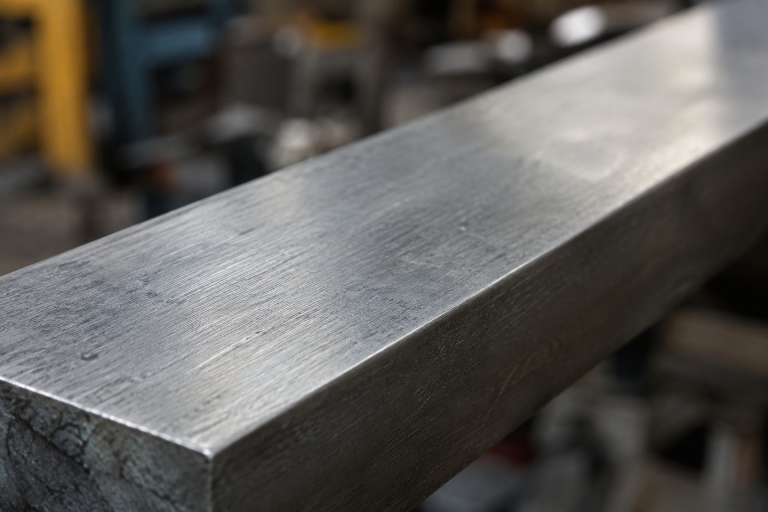
- Flat and square bar: Useful for brackets, fixtures, supports, keys, and custom machined parts.
- Plate: Common for bases, guards, frames, liners, and larger fabrications.
- Threaded rod: Used for fastening, clamping, and load-transfer applications.
- Shafting: Useful when straightness, finish, and consistent diameter are important.
Metric and imperial sizes are not automatically interchangeable. One inch equals exactly 25.4 millimeters, as reflected in standard SI length guidance, but a converted measurement is not necessarily an approved substitute for a drawing dimension. Confirm diameter, width, thickness, length, tolerance, straightness, and machining allowance before ordering.
Review Quality Documents and Traceability
Clear material records are especially important for critical parts, regulated work, and customer-controlled specifications. Depending on the job, buyers may need mill test reports, heat or lot identification, chemical composition, tensile and yield results, hardness information, applicable ASTM or project requirements, and inspection records. These documents help connect received material to the stated properties and purchasing specification.
Control Costs Without Cutting Performance
Compare total cost rather than price per pound alone. Include freight, cutting, machining, welding preparation, heat treatment, coating, inspection, lead time, and scrap. Home Solar System Guide Standard stock sizes may offer cost and availability advantages, while near-net-size material can reduce removal time and yield loss. Any proposed substitute should be reviewed against the drawing, application requirements, and availability before it reaches the shop floor.
Use a Practical Selection Checklist
- What loads, impacts, and cycles will the part experience?
- Will it face corrosion, heat, cold, chemicals, or abrasion?
- Does the job prioritize strength, hardness, machinability, weldability, or corrosion resistance?
- What form and dimensions will minimize waste?
- Are metric or imperial dimensions specified?
- What tolerances, test reports, and traceability records are required?
- Can the material be fabricated with available equipment and procedures?
- Has a responsible engineer reviewed safety-critical selections?
Common Questions About Steel Selection
Is stronger steel always better?
No. Higher strength may add cost or introduce machining, welding, and forming constraints. It is valuable when the design requires it, not simply because it is available.
What is the difference between a steel grade and a steel shape?
The grade describes the material and its specified properties. The shape describes how it is supplied, such as round bar, flat bar, plate, or shafting. Both affect the final result.
Can one steel grade be substituted for another?
Not without review. Similar names or comparable dimensions do not ensure equal chemistry, mechanical properties, fabrication behavior, or acceptance under a project specification.
Final Takeaway
Good steel selection starts with the finished part rather than the catalog shelf. By evaluating service conditions, fabrication methods, stock form, dimensions, documentation, availability, and total project cost, buyers can make more reliable decisions. For structural applications that involve design and fabrication questions, technical discussions on structural steel practice can provide useful context alongside project-specific engineering requirements.