The New DIY Using 3D Generation Prototype Bespoke Furniture
Designing for small cottages or farmhouse-style homes presents a unique challenge. There is a constant need for character and soul within limited physical dimensions. Standard furniture often feels too bulky. Custom-made pieces come with high lead times and blind investment risks. This is where Neural4D (N4D) is transforming the DIY landscape. By leveraging PBR material 3D generation, homeowners and industrial designers can now prototype bespoke furniture that fits specific spatial constraints. This ensures the final product maintains the warmth and tactile texture of a cozy home.
Developed through a collaboration of top research institutions like Oxford and DreamTech, Neural4D is not a mere creative tool. It is a specialized production suite built on the Direct3D-S2 architecture. Its mission is to bridge the gap between a simple 2D sketch and a production-ready 3D model. This ensures every asset is technically sound for manufacturing or 3D printing.
The High Cost of Physical Prototyping in Manufacturing
The traditional furniture manufacturing cycle is notoriously slow. From the initial hand-drawn sketch to the final physical prototype, the process often spans weeks of back-and-forth between design teams and factory floors. In small-scale or custom cottage design, these inefficiencies are amplified:
Material Overhead: Prototyping complex wooden joints or ornate metal frames results in significant scrap when using trial-and-error methods.
Labor Latency: Skilled 3D artists often spend hours on retopology. They must fix the disorganized triangle soup that standard AI generators produce.
Spatial Uncertainty: For small cottages, an inch of error can make a piece of furniture unusable. Virtual prototyping allows for precise spatial testing before any wood is cut.
By integrating PBR material 3D generation directly into the early design phase, companies can perform visual approvals and virtual stress tests. This significantly increases the ROI of the product development cycle.
Solving the Non-Manifold Crisis in Industrial 3D
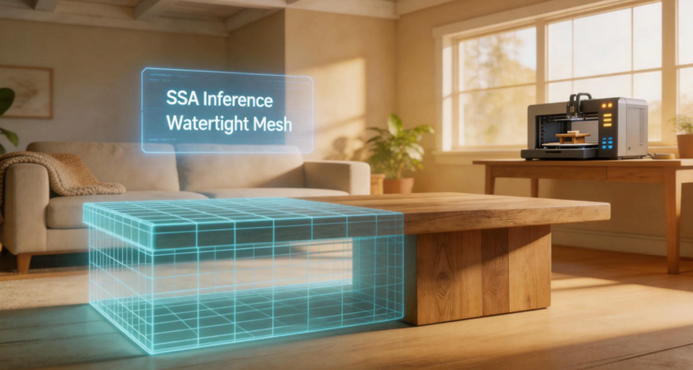
A major pain point for manufacturers adopting 3D printing for furniture components is the poor quality of standard AI outputs. Most generators create a visual shell that is non-manifold, containing holes that cause industrial 3D printers to fail.
The Watertight Standard Neural4D
Addresses this by ensuring all outputs are watertight. When you export an asset using the Direct3D-S2 engine, the geometry is mathematically closed. This means a decorative corbel or a table leg model can go straight into a slicer without manual hole-patching.
Clean Topology for Industrial Use
Unlike disorganized generators, N4D focuses on quad-dominant structures. This clean edge flow is critical for designers who need to apply subdivision surfaces to ergonomic chairs or high-end upholstered sofas. It prevents the pinching effect during rendering or physical casting.
Scaling Production with SSA and Batch Inference
For a furniture brand launching a seasonal collection, generating models one by one is a bottleneck. This is where Spatial Sparse Attention (SSA) becomes a decisive competitive advantage.
12x Inference Speed
The SSA mechanism optimizes the engine by focusing compute power only on active voxels. This results in a 12x speed increase in inference. It allows for batch inference, where a manufacturer can feed an entire catalog of reference photos into the Neural4D API and receive high-resolution assets overnight.
Computational Overhead Reduction
By reducing the computational overhead, N4D allows small-scale artisanal workshops to access high-end 3D generation. They do not need to invest in massive on-site GPU farms. The system delivers 2048³ resolution native geometry that captures every detail of a wood grain or a metal fastener.
Material Fidelity: PBR Workflows for Realistic Home Styling
For a piece of furniture to feel homey, the materials must react to light exactly like their real-world counterparts. A leather armchair must have a specific sheen. An oak table must show the depth of its grain.
Pure Albedo and Lighting Separation
Traditional AI assets often have lighting baked into the texture. This creates dead shadows that look unrealistic in different environments. Neural4D generates pure albedo textures. This ensures that the color data is clean and independent of the environment.
Standardized Material Maps
Alongside the geometry, the system outputs necessary Normal, Roughness, and Metallic maps. This PBR workflow ensures that when a manufacturer drops a model into a web viewer or a VR showroom, the materials look identical to the physical product.
Breaking Ecosystem Silos
A common fear in manufacturing is being trapped in a closed ecosystem. An asset is useless if it cannot be exported to the software the factory actually uses. Neural4D maintains a strict policy of interoperability.
Native Format Support: Export directly to .fbx for CAD software, .obj for Blender, or .stl for immediate 3D printing.
Pipeline Integration: The Neural4D API is designed to slot into existing PLM systems. This ensures a seamless flow from the designer’s desk to the manufacturing floor.
Conclusion: Efficiency as the Ultimate Competitive Edge
In the fast-paced world of interior design and furniture manufacturing, the ability to iterate quickly is the only way to maintain a high ROI. Neural4D provides the scaffolding that designers need to eliminate the blank canvas struggle. By combining Deterministic output with PBR material 3D generation, N4D is not just generating models. It is engineering the future of high-fidelity, industrial-grade 3D production.