
6 Reasons to Use an Absolute Angle Encoder for Accuracy
There are many industries that depend on precision-linked devices and components. A lack of these components leads to equipment or device failure and costly financial losses. For example, a worker passed away when a concrete-filled container fell from a crane on him in Australia.
That’s why using components like an absolute angle encoder can help you optimise your industrial operations and prevent such instances.
Absolute Angle Encoders Ensuring Precision and Accuracy
Take a look at the following 6 points to understand how absolute angle encoders bring precision and accuracy:
1. Immediate Position Feedback After Power Loss
One of the first advantages of using absolute angular encoders is that they relay their position immediately after a power loss. However, incremental rotary encoders do not do that. That’s because absolute angle encoders store their positional data in non-volatile memory.
This memory is present in the electronic board, which processes the signals from the photodetectors. So in the event of a power loss, the board preserves the encoder’s last position. You will not need to provide a reference point to obtain this position.
Their capacity to retain the position even after a power loss is critical for systems where recalibration is time-consuming. For example, consider satellites. If a satellite does not store its position, then it could veer off course and cause a great financial loss.
Another example is in elevators. Absolute angle encoders are vital for relaying the exact position of the elevator shaft.
2. High Resolution for Ultra-Precise Positioning
Absolute angular encoders have a higher degree of accuracy as compared to incremental rotary encoders. In fact, they offer between 12 to 18 bits of resolution. Some modern absolute encoders also offer up to 30 bits of resolution.
The number of bits denotes the number of positions they can map in every revolution.
This resolution is denoted by ‘2^n’ or 2 to the power of n. Here, ‘n’ stands for the number of positions it can record per bit. Take a look at the table below for an idea of the same.
| Resolution (Bits) | Positions per Revolution |
| 12 | 4,096 |
| 16 | 65,536 |
| 18 | 262,144 |
| 20 | 1,048,576 |
| 22 | 4,194, 304 |
| 24 | 16,777,216 |
| 30 | 1,073,741,824 |
Table 1: Resolution of Absolute Angular Encoders
Their accuracy is vital in high-end CNC machines, lithography, or coordinate measuring machines. Coordinate measuring machines are used to measure components like turbines in aerospace and confirm the accuracy of dies and molds.
3. Long-Term Durability
Absolute angle encoders are built to withstand multiple forms of environmental stress, like dust, moisture, and vibration. These encoders are placed within housing material like stainless steel or aluminium.
This means that they can withstand temperatures of up to 400 degrees Celsius. Apart from that, these encoders can also withstand explosive environments. They are also low-maintenance, making them cost-effective for your industry.
Their durability makes them ideal for mission-critical systems like defense tracking. They are also used in sectors like aerospace and the oil and gas industry.
4. Multi-Turn Position Tracking Without Battery Backup
Advanced absolute encoders can track both single-turn and multi-turn positions. These positions are measured by single-turn and multi-turn absolute angular encoders, respectively.
Single-turn absolute encoders measure the positions for rotations of less than 360 degrees. For example, they are used to map the pivot point of doors and the angle at which they open.
On the other hand, multi-turn absolute encoders measure the positions by tracking the rotational degree and the total number of rotations. They are used to map linear motion across a longer length.
For example, they are used to map the movement of crane arms across a certain distance. The impressive thing is that these absolute angle encoders can map these positions without any battery backup.
This is possible due to the electronic system, which stores the position in the event of a power loss. So you don’t need to carry out any maintenance-related inspections related to batteries.
Take a look at the table below for a glimpse at the comparison of multi-turn encoders operating without battery backup:
| Technology | Tracks Multi-Turn Positions | Battery Needed | Maintenance-Free |
| Mechanical Gears | Yes | No | No (but wear risk) |
| Battery Backup | Yes | Yes | No |
| Magnetic/Inductive | Yes | No | Yes |
Table 2: Multi-Turn Encoder Technologies Comparison
5. Improved Noise Immunity and Signal Integrity
Absolute angle encoders use serial communication for seamless data transfer between devices. One of the forms of serial communication is the Synchronous Serial Interface or SSI.
However, a disadvantage of SSI is that they do not allow the encoder to communicate with the PLC.
That’s why some absolute angular encoders utilise the Fieldbus protocol. These communication systems ensure seamless communication between the encoders and PLCs or actuators. They also ensure protection against electromagnetic interference.
Their immunity to electromagnetic interference makes them ideal for applications involving industrial automation, EVs, and medical imaging.
6. Simplified System Integration & Reduced Downtime
Another advantage of absolute angular encoders is that they reduce the need for external sensors or complex motion controllers. That’s because they can map and store the position of the shaft or associated device accurately due to their electronic board.
This ability to store the position of the device and relay the same in the event of a power loss removes the need for motion control sensors and devices.
So you can integrate them into existing systems seamlessly without creating extra space. Apart from that, some absolute angle encoders have advanced integrated diagnostic features.
These diagnostic features alert operators to any potential faults, allowing for predictive maintenance.
Where Are Absolute Angular Encoders Used?
Consider the infographic below to learn about some applications of absolute angle encoders:
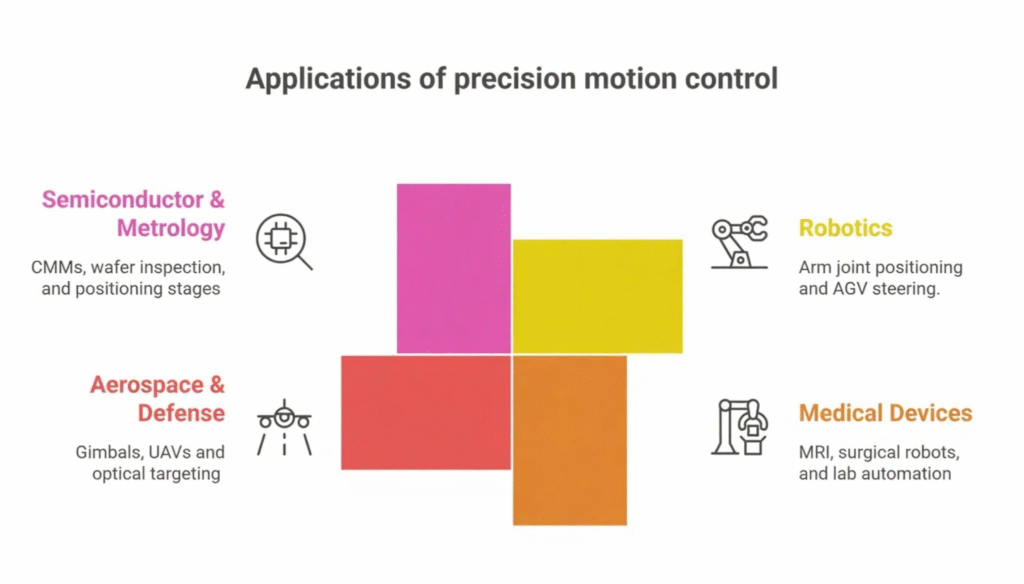
Infographic 1: Applications of Absolute Angular Encoders
How To Choose the Right Absolute Angle Encoder?
Consider the infographic below to learn about how to choose the right absolute angular encoder
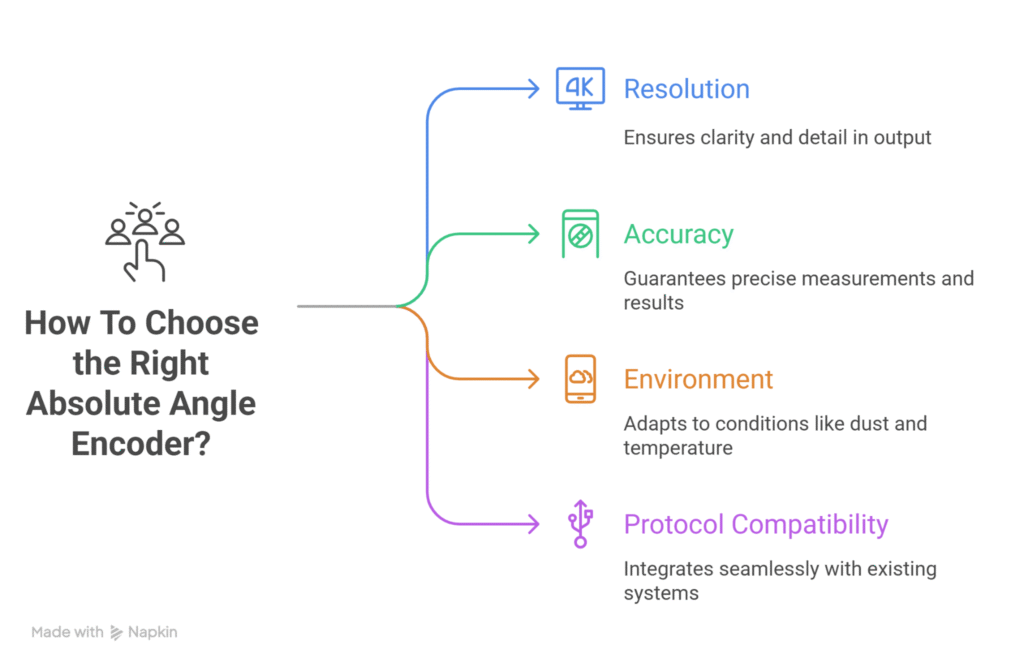
Infographic 2: How To Choose the Right Absolute Angle Encoder?
Wrapping Up
Absolute angular encoders have multiple advantages over incremental rotary encoders. You should consider the type of encoder you should use based on your needs and other factors like the prevailing environment.
Explore different types of absolute angular encoders, like optical and magnetic absolute angular encoders. You can contact a reputed manufacturer of these devices to learn more and decide which ones suit your needs.
Need Long-Term Accuracy in Your Motion System?
Get in touch with a reputed manufacturer today to purchase the best absolute encoder solutions today!