
Innovative Strategies for Industrial Pump Maintenance
Maintaining industrial pumps is essential for the reliability and efficiency of critical infrastructure across a wide range of industries. As operational demands increase and equipment complexity grows, the need for advanced maintenance practices becomes ever more pressing. Organizations seeking to optimize pump performance and minimize unexpected breakdowns need to embrace forward-thinking maintenance strategies. For a practical resource on pump maintenance best practices and high-performance equipment, visit this website.
Traditional maintenance methods like scheduled inspections and reactive repairs are quickly becoming insufficient in the face of data-driven industrial environments. Companies are now harnessing predictive analytics, artificial intelligence, and advanced monitoring technologies to ensure seamless operations and elevate workforce competence. This comprehensive approach not only improves reliability but also helps control costs and boost overall safety in manufacturing, water treatment, chemical processing, and more.
With so many advancements on the horizon, understanding how to implement these innovative strategies is crucial for maintenance teams and decision makers alike. In this article, we break down key approaches, provide industry examples, and address a crucial aspect that is often overlooked: training and upskilling personnel for new technologies.
Predictive Maintenance: A Proactive Approach
Predictive maintenance leverages continuous monitoring and data analysis to forecast failures before they disrupt processes. This method moves beyond the limitations of time-based or reactive repairs, relying on condition-based indicators, such as vibration, temperature, and pressure, to determine when maintenance interventions are necessary. Industry leaders like Eaton have introduced advanced motor analytics software that can analyze motor current signatures via machine learning. These systems allow for early identification of emerging issues; corrective actions can be taken before the equipment experiences significant wear or fails entirely. Eaton’s approach demonstrates that predictive maintenance can be performed without the need for numerous direct sensors, lowering the barrier to implementation.
An added advantage of predictive maintenance lies in its potential for seamless scalability across numerous facilities and different types of pump assets. Through the implementation of cloud-based platforms, organizations can aggregate and analyze data from geographically dispersed assets, identifying trends and systemic issues on a larger scale. This holistic view allows for more strategic resource planning, such as scheduling maintenance visits only when certain thresholds are met rather than following arbitrary timelines. Over time, predictive maintenance not only prolongs equipment lifespan but also supports environmental sustainability by reducing unnecessary part replacements and optimizing energy consumption across entire operations.
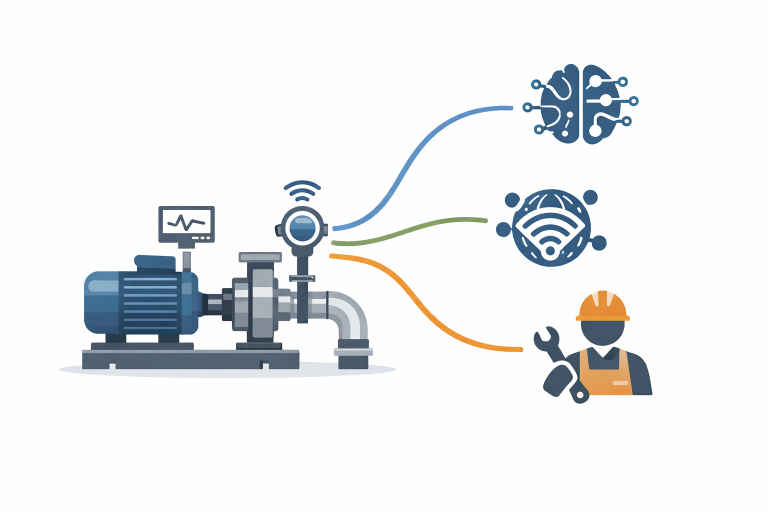
Integrating AI and Machine Learning
Artificial intelligence (AI) and machine learning represent transformative technologies in industrial pump maintenance. By processing large datasets from equipment sensors, AI algorithms can learn normal operating parameters, quickly pinpoint anomalies, and suggest tailored maintenance responses. Recent studies on machine learning for fault diagnosis support these claims, revealing that models built specifically for industrial pumps excel in both precision and speed when identifying problems. Leveraging machine learning not only augments reliability by decreasing both false positives and missed warnings, but also improves energy efficiency and helps reduce lifecycle costs for industrial equipment. For further reading on how machine learning impacts industrial equipment across sectors, see the comprehensive overview on Eaton’s Motor Analytics page.
As AI continues to evolve, the depth and breadth of insights it can offer for maintenance are rapidly expanding. Predictive models can learn from vast historical datasets, spotting subtle patterns that a human operator might overlook. Furthermore, AI-driven maintenance recommendations can be automatically integrated into enterprise resource planning (ERP) systems, triggering preventive work orders or flagging high-risk assets for immediate attention. Over time, this integration reduces maintenance backlogs and fosters a culture of continuous improvement by providing actionable feedback loops between maintenance actions and their real-world outcomes. As a result, organizations gain a competitive edge through reduced downtime, lower costs, and a data-rich foundation for future process optimization.
Leveraging IoT for Real-Time Monitoring
The Internet of Things (IoT) is transforming the way organizations monitor and maintain industrial pumps. IoT-enabled devices provide real-time performance data, such as flow rate, pressure, and vibration, directly from equipment to maintenance teams, even at remote or inaccessible locations. By aggregating this data in centralized dashboards, plant managers can continuously track the health of pumps and schedule interventions based on actual conditions instead of rigid calendars. For example, United Utilities recently trialed an AI-based smart monitoring system from Samotics, using IoT to increase the efficiency and reliability of critical pump assets. Real-time diagnostics enable predictive and even prescriptive interventions that safeguard both equipment and production goals. To learn more about this trial, see the detailed report on Samotics’ website.
Additionally, IoT platforms can support automated alerts and remote troubleshooting, which minimizes the need for on-site personnel and expedites decision-making when anomalies are detected. Advanced IoT systems integrate easily with mobile devices, giving maintenance teams immediate access to machine data and historical trends wherever they are. This streamlined communication flow not only reduces response times but also ensures that necessary spare parts and resources can be dispatched efficiently, minimizing unnecessary downtime. As regulations around industrial safety and asset transparency tighten, these real-time monitoring capabilities also aid organizations in maintaining compliance and improving documentation processes.
Training and Upskilling Maintenance Personnel
Even the most advanced maintenance systems require skilled operators and technicians to maximize their value. The evolving nature of maintenance technology means that traditional mechanical expertise must be paired with digital literacy and analytical thinking. Organizations that prioritize ongoing training, certifications, and mentorship programs are better equipped to adapt to emerging tools and processes. Upskilled personnel are also more confident in troubleshooting, interpreting diagnostics, and collaborating with IT departments for smarter asset management. In turn, this reduces human error, strengthens team morale, and empowers the workforce to actively contribute to high-reliability operations and business success.
Upskilling initiatives also contribute to stronger knowledge sharing and a culture of adaptability, as experienced workers can mentor newer team members and encourage a proactive mindset. Leveraging e-learning platforms, simulation-based training, and cross-functional workshops enables organizations to cover technical, digital, and leadership competencies in tandem. As technology continues to evolve, a commitment to ongoing education ensures that maintenance teams are not only reactive but also proactive, anticipating future trends and continually optimizing asset management strategies. This strategic investment in people can yield productivity gains, reduced employee turnover, and a resilient maintenance team ready for any challenge.
Conclusion
The landscape of industrial pump maintenance is shifting rapidly. By adopting predictive maintenance, integrating AI and machine learning, implementing IoT-driven monitoring, and investing in workforce skills, companies set themselves apart in competitive, technology-driven markets. These strategies do more than keep pumps running. They foster resilience, reduce costs, and support a culture of continuous improvement, which is vital to sustainable success in modern industry.
As technology continues to advance, the organizations that actively pursue innovative maintenance strategies and invest in both human and digital capital will be best positioned for long-term growth. Embracing a holistic, future-focused approach enables businesses to anticipate challenges, navigate evolving regulatory requirements, and maintain a reputation for reliability. Ultimately, leveraging advanced maintenance techniques not only protects critical equipment but also elevates the entire organization to thrive in the complex landscape of industrial operations.